
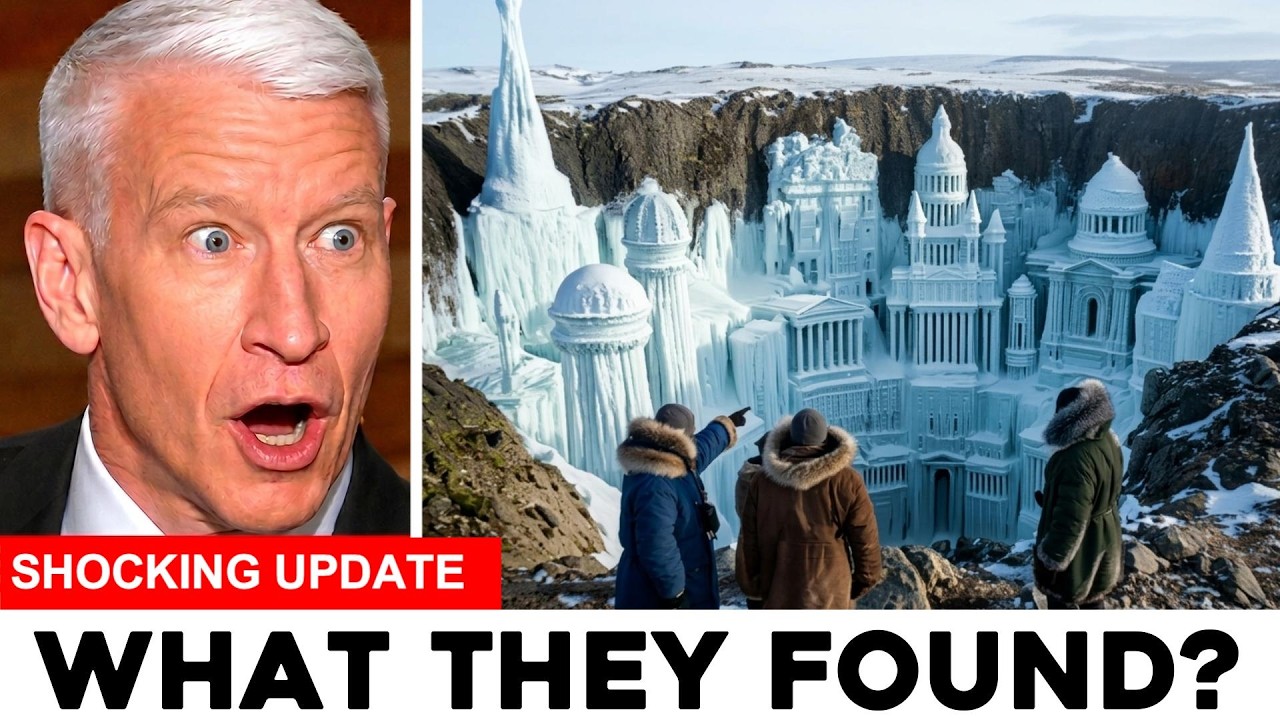
Linda Moulton Howe: The Beings Match Nothing We Know
Linda Moulton Howe examines an alleged Antarctic facility where strange beings, impossible markings and colossal obsidian rooms challenge everything we know

Three miles beneath the Antarctic ice.
A single ramp descends into darkness.
According to testimony presented by Linda Moulton Howe, one man allegedly travelled down it to retrieve a language specialist.
What he supposedly encountered below sounds less like archaeology—and more like something completely outside our understanding.
Vast rooms.
Black obsidian walls.
Thousands of strange markings.
And beings described as tall, hairless and humanoid.
If the account is accurate, this would be extraordinary.
But another question emerges.
What if the story is not describing a ruin at all?
The Black Obsidian Chambers Beneath Antarctica

The alleged journey begins beneath the Antarctic ice.
According to the account, the passage descends at a constant angle for approximately three miles.
At the bottom, enormous chambers reportedly appear.
One is said to measure around three square acres.
Another reportedly reaches nine square acres.
Above them are ceilings estimated at eighty feet high.
That alone would make the alleged site difficult to explain.
Then comes the material.
Black obsidian reportedly covers the walls.
Across those walls are said to be thousands of carved markings.
A language specialist was allegedly brought in to study them.
The forms supposedly resemble elements of ancient writing systems.
Yet the testimony claims they also contain patterns with no known terrestrial equivalent.
That is where the story becomes much stranger.
The Markings and Beings Inside the Facility
The most extraordinary claim concerns the precision of the markings.
According to the testimony, hundreds were examined using laser measurements.
The alleged result?
Every marking measured exactly 7.5 inches.
Not approximately.
Exactly.
If independently verified, such consistency would demand an explanation.
The account attributes the markings to a technology capable of altering extremely hard stone with extraordinary precision.
But then the story moves beyond archaeology.
The corridors are reportedly maintained at around 69 degrees Fahrenheit.
Lights allegedly activate as someone approaches.
Huge doors reportedly remain sealed between sections.
And the facility is described as operational rather than abandoned.
Then come the beings.
They are allegedly humanoid, extremely tall and hairless.
The testimony says they are neither traditional Greys nor insect-like entities.
Instead, they are described as something that appears almost human—but not quite.
That distinction is important.
Because if these descriptions were ever independently confirmed, the question would no longer be simply who built the chambers.
It would be who still uses them.
And why?
Final Verdict: What Could Really Be Beneath Antarctica?
The Antarctic ice genuinely hides an extraordinary world.
Scientists have mapped mountains, valleys, lakes and ancient landscapes beneath the continent.
However, the specific underground facility described in this testimony has not been established by publicly verified archaeological evidence.
That matters.
Extraordinary measurements need independent documentation.
So do the alleged inscriptions, chambers and beings.
At the same time, Antarctica remains one of the least accessible environments on Earth.
Much of what lies beneath its ice cannot simply be inspected like an ordinary archaeological site.
That creates an enormous difference between what has been scientifically demonstrated and what remains part of testimony and speculation.
Could a future discovery reveal something completely unexpected?
Possibly.
Could these claims eventually prove to have a conventional explanation?
That remains possible too.
For now, there is no verified evidence establishing an active non-human facility three miles beneath the Antarctic ice.
But the story raises an irresistible question.
How much of Antarctica’s hidden world have we actually seen?
And if something truly extraordinary is waiting beneath the ice, the next discovery could change the conversation completely.
 Watch the Video
If an active facility really exists beneath the Antarctic ice, who built it—and why would its doors, lights and enormous chambers still be functioning?