
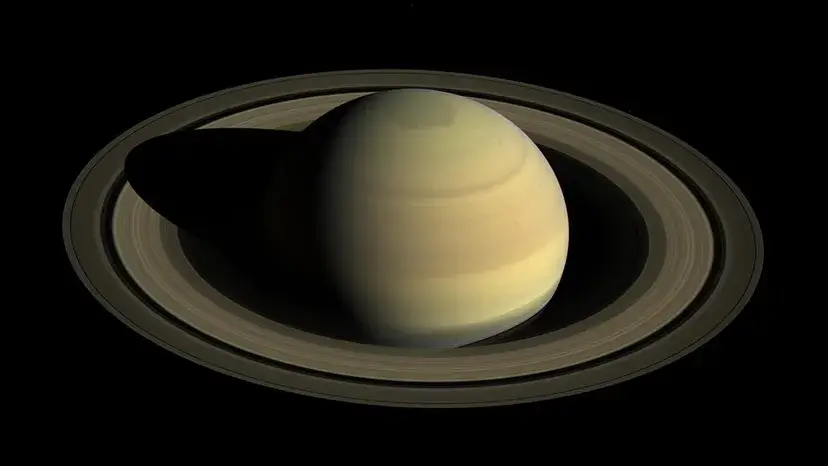
The Book of Enoch Says Saturn Is Not a Planet — And Describes What It Actually Is
The Book of Enoch describes strange celestial realms that some interpret as prison worlds—could one ancient mystery point to Saturn?

Saturn has always looked different.
Its vast rings make it one of the most recognisable worlds in our solar system.
But what if an ancient text described something far stranger than a distant gas giant?
The controversial Book of Enoch presents a radically different vision of the heavens.
In its cosmology, celestial bodies are not simply lifeless objects moving through space.
They form part of a vast supernatural architecture.
Some are presented as stations, realms, or places connected to divine beings and cosmic judgement.
At the outer edges of creation, Enoch describes a desolate realm where rebellious heavenly entities await their punishment.
Some modern interpretations connect this imagery with Saturn.
But is that actually what the ancient text says?
The Ancient Secret Hidden Behind Saturn’s Rings

The Book of Enoch presents a universe unlike the one described by modern astronomy.
This Is Why The Book of Enoch Got Banned
Enoch’s journeys take him through the heavens, where angels reveal hidden structures and mysterious regions beyond the familiar world.
The text describes celestial movements, appointed gates, stars, and heavenly beings.
It also portrays certain rebellious entities as imprisoned while awaiting divine judgement.
These passages have fascinated readers for centuries.
Modern theories sometimes reinterpret the prison imagery as a description of distant planetary realms.
Saturn becomes especially intriguing because of its isolated position, enormous rings, and unusual appearance.
Yet the Book of Enoch never simply identifies Saturn as a prison planet.
That connection comes from later interpretation.
Did Enoch Describe Saturn as a Cosmic Prison?
The Saturn theory becomes more speculative when ancient symbolism meets modern planetary imagery.
Saturn’s rings can create the appearance of a vast cosmic boundary surrounding the planet.
For some interpreters, that geometry resembles an enormous containment structure.
The comparison is visually compelling.
But visual similarity does not establish an ancient connection.
The Book of Enoch describes supernatural prisons, darkness, fire, and fallen beings—but it does not provide a modern astronomical description of Saturn.
Likewise, astronomy gives us a very different picture.
Saturn is a gas giant composed primarily of hydrogen and helium, with a complex ring system and numerous moons.
No scientific evidence shows that it functions as a prison for supernatural entities.
Final Verdict: What Does Enoch Really Describe?
The Book of Enoch offers a fascinating vision of a layered and highly ordered cosmos.
Its descriptions of imprisoned heavenly beings and distant realms have inspired countless interpretations.
But there is an important distinction between what Enoch actually describes and what modern theories claim those descriptions represent.
The text does not scientifically identify Saturn as a cosmic containment vessel.
Nor does modern astronomy provide evidence for such a function.
The Saturn connection remains an interpretation built from ancient cosmology, symbolism, and later speculation.
Yet the mystery remains fascinating.
Perhaps the most intriguing question is not whether Enoch secretly described Saturn—but why an ancient text imagined the heavens as a place filled with hidden realms, celestial governors, and cosmic prisons.
That strange vision continues to capture the imagination thousands of years later.
 Watch the Video
Could the Book of Enoch’s descriptions of cosmic prisons and rebellious heavenly beings have inspired the idea that Saturn is something far stranger than the gas giant modern astronomy describes?