
Voyager 2 Has Made an “Unimaginable” Discovery After 49 Years in Space
After forty-nine years in space, Voyager 2 is sending back extraordinary data from the darkness beyond our Solar System, raising remarkable new questions about what may exist there

For nearly half a century…
Voyager 2 has been travelling towards the unknown.
Long after its planetary mission ended…
Its greatest discoveries were only just beginning.
Every kilometre carried the spacecraft farther from the Sun.
Farther from the planets.
And closer to a place no spacecraft had explored before.
Then it crossed an invisible boundary.
Everything scientists expected began to change.
Beyond the reach of the Sun’s solar wind, Voyager 2 began sending back measurements unlike anything scientists had observed before. The data offered humanity its clearest glimpse yet into interstellar space, revealing an environment far more complex than researchers had anticipated.
You’ll see exactly what Voyager 2 discovered by the end.
And why some of its most intriguing observations continue challenging scientists today.
It All Changed Beyond an Invisible Boundary
The moment looked ordinary.
There was no explosion.
James Webb Just Captured the Unimaginable Moments Ago
No dramatic flash of light.
Yet it marked one of the greatest milestones in space exploration.
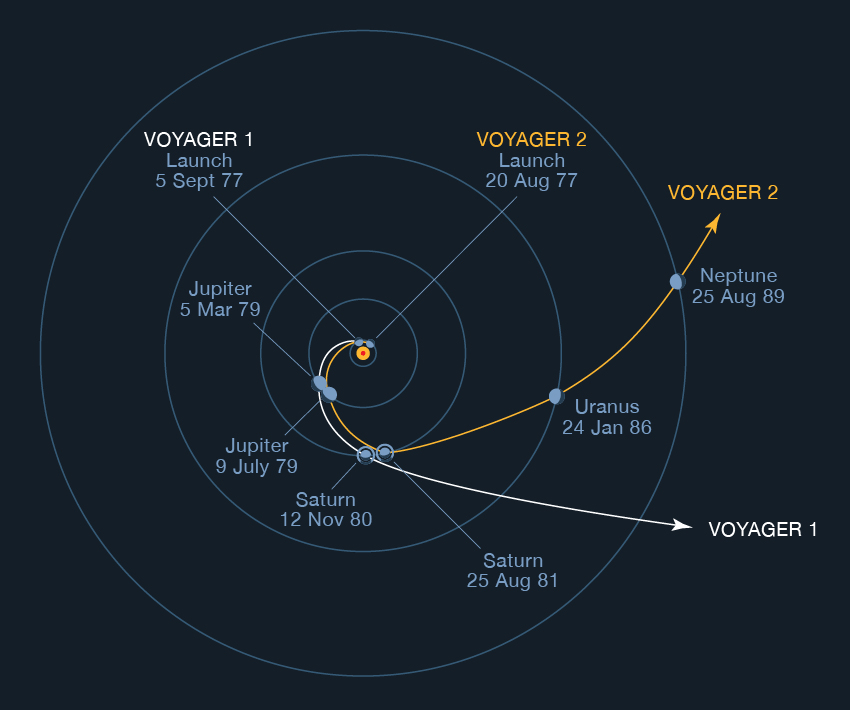
In 2018, Voyager 2 crossed the heliopause—the invisible boundary where the outward flow of the Sun’s solar wind gives way to the interstellar medium. It became only the second spacecraft in history to enter interstellar space while continuing to transmit scientific data directly back to Earth.
Scientists finally had the opportunity to compare the environment inside our Solar System with the vast region beyond it.
The journey was no longer about reaching the edge.
It was about discovering what lay beyond.
The First Signals Changed Everything Scientists Believed
The first measurements surprised researchers.
Cosmic rays increased dramatically.
The solar wind almost disappeared.
Plasma became denser than many scientists expected.
Perhaps most surprising of all, Voyager 2 found that the magnetic field beyond the heliopause remained closely aligned with the field inside the Solar System, challenging several expectations about how this invisible boundary would behave.
Researchers continue analysing observations including:
- The behaviour of high-energy cosmic rays.
- Unexpected changes in plasma density.
- The structure of the interstellar magnetic field.
- How the heliopause separates our Solar System from interstellar space.
Some commentators have suggested that future interstellar missions could one day identify entirely new phenomena, including the possibility of detecting technological signatures if they exist elsewhere in the universe. However, Voyager 2 has not detected extraterrestrial intelligence, and no scientific evidence currently supports such a conclusion.
Every answer brought another question.
The deeper Voyager travelled…
The more mysterious interstellar space became.
Final Verdict: The Greatest Mystery Still Lies Ahead
Nearly fifty years after launch…
Voyager 2 continues its journey.
Its power is slowly fading.
Yet it is still returning valuable scientific data from a region humanity has barely begun to understand.
Every transmission reminds us that interstellar space is not an empty void but a frontier still waiting to be understood. Nearly fifty years after launch, Voyager 2 continues proving that some of humanity’s greatest discoveries begin only after the original mission has ended.
Sometimes the greatest discoveries are not the ones we expect to find.
They are the ones waiting beyond the horizon.
 Watch the Video
Do you think Voyager 2’s greatest discovery has already been made, or could its journey through interstellar space still reveal something that changes everything we know about the universe?