
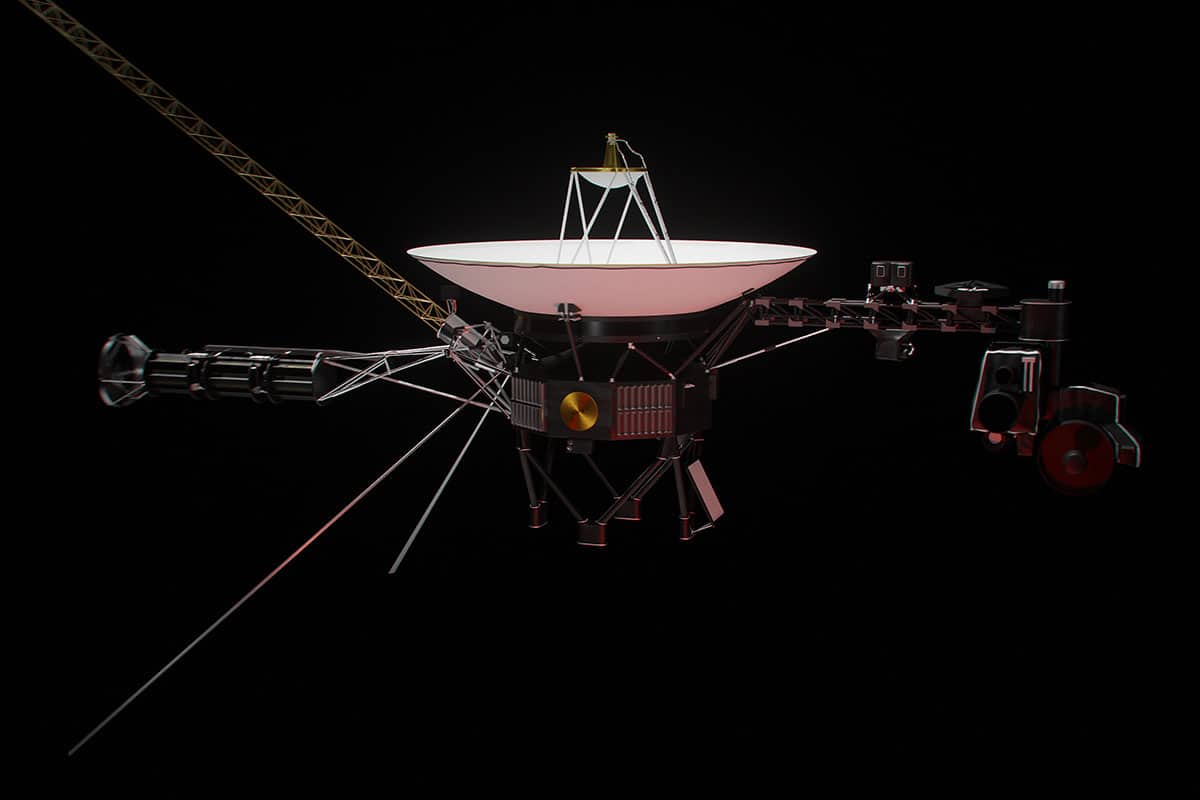
Voyager 1 Just Sent Back Something NASA Wasn’t Expecting
Voyager 1 is sending strange data from interstellar space, fuelling speculation that its unexpected readings could point to something beyond science

Nearly fifty years after leaving Earth, Voyager 1 is still talking to us.
The spacecraft is now travelling through interstellar space.
Its journey has taken it farther from home than any human-made object in history.
Yet its instruments continue detecting the environment around it.
That alone is extraordinary.
Some measurements coming back from Voyager 1 have also raised questions about what is happening in the darkness beyond the Sun’s influence.
The science is fascinating.
The speculation is even stranger.
Could an unexpected signal simply reveal something new about interstellar space?
Or could there be another explanation?
For decades, Voyager 1 has been humanity’s distant messenger.
Now, its faint transmissions may be giving us clues about a region of space we have barely explored.
Voyager 1 Detects Something Deep Beyond Our Sun

Voyager 1 crossed the heliopause in 2012.
That boundary marks the transition between the Sun’s solar wind and the surrounding interstellar medium.
Since then, the spacecraft has continued sending measurements from an environment no other functioning probe has explored in quite the same way.
Its instruments have detected changes in plasma conditions.
They have also recorded waves travelling through the thin material between the stars.
These measurements allow scientists to study how our Solar System interacts with its galactic surroundings.
But there is something remarkable about the mission.
Voyager 1 was never designed specifically to investigate interstellar space.
Its original mission focused on the outer planets.
Everything it discovers beyond the heliopause is effectively an extended mission into unknown territory.
That makes every surviving measurement valuable.
Even tiny changes in the data can reveal something about the space surrounding the spacecraft.
Sometimes, unexpected results lead to the most interesting questions.
Could there be phenomena out there that our existing models do not fully describe?
The Strange Mystery Behind Voyager’s Latest Signals
The phrase “strange signal” can make Voyager 1 sound more mysterious than it really is.
Its communications are extremely faint.
The spacecraft is billions of kilometres from Earth.
NASA’s Deep Space Network must detect and interpret those signals across an enormous distance.
Yet the data remains scientifically useful.
Voyager has detected plasma waves and other disturbances in the interstellar medium.
Scientists can use those measurements to study the density and behaviour of material between stars.
Still, this is where the more speculative theories begin.
Some UFO researchers have wondered whether an unexpected transmission from such a distant spacecraft could indicate something artificial nearby.
Others have imagined that Voyager might eventually encounter an unknown object or receive a signal from another civilisation.
There is no confirmed evidence that this has happened.
But the possibility is fascinating.
Imagine a spacecraft launched during the era of cassette tapes eventually becoming humanity’s accidental listener in interstellar space.
If something unusual were ever detected, Voyager could potentially become the first machine from Earth to notice it.
For now, however, the mystery remains firmly in the realm of possibility.
Final Verdict: What Is Voyager 1 Really Detecting?
The established science is already remarkable.
Voyager 1 is operating in interstellar space and continuing to provide measurements from a region far beyond the planets.
Its data helps researchers study plasma, magnetic fields, and the boundary between the Sun’s environment and interstellar space.
Those discoveries do not require an alien explanation.
At the same time, science has only sampled a tiny region of the space between the stars.
There is still much we do not understand.
An unusual measurement could therefore become important without being extraterrestrial.
If Voyager ever detected a genuinely artificial signal, scientists would need extraordinary evidence before reaching that conclusion.
The current data does not establish such a discovery.
But Voyager’s journey is far from ordinary.
A machine built by humans nearly half a century ago is still sending information across the darkness.
Every transmission is a message from a place no human has ever visited.
And perhaps that is the strangest part of all.
We sent Voyager into the unknown.
Now, almost fifty years later, it is still telling us what it finds there.
 Watch the Video
If Voyager 1 detects something genuinely artificial in interstellar space, would we recognise the signal—or could we mistake it for a natural phenomenon?