


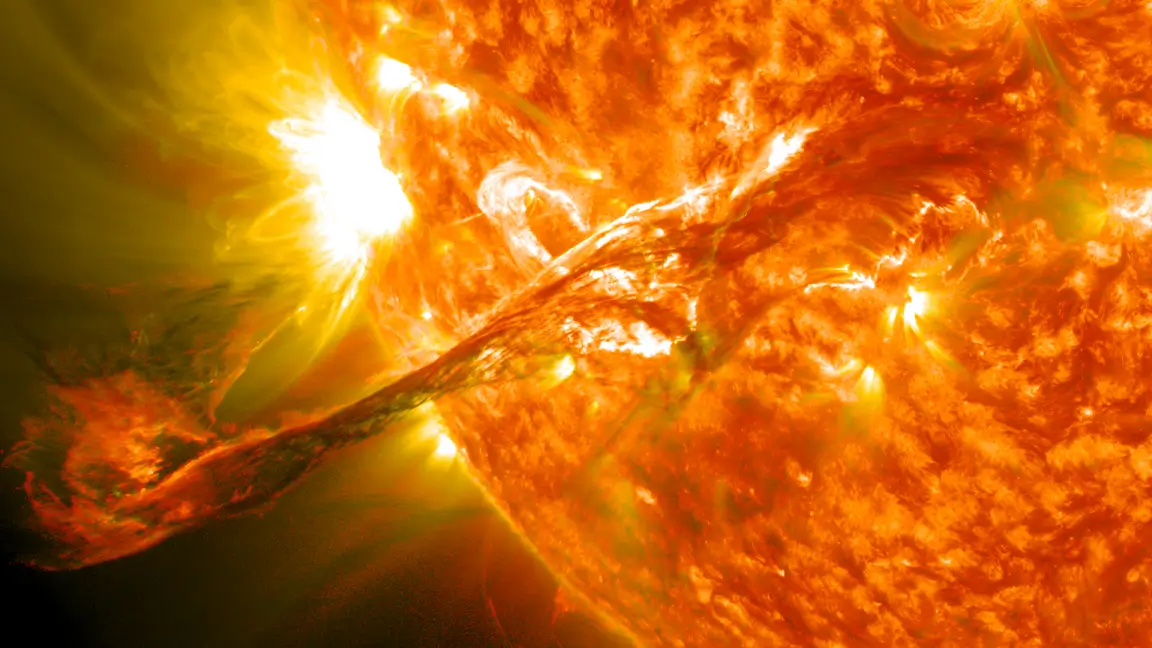
A colossal coronal hole erupted on the sun, unleashing a torrent of high-speed solar wind toward Earth. Spanning a width equivalent to more than sixty Earths, this breach in the sun’s magnetic field created elevated geomagnetic activity. Satellites, communication networks, and power grids experienced increased stress. Recently, the interstellar object 3I/ATLAS passed through our solar system, coming within 1.8 astronomical units of Earth. This rare convergence of cosmic events underscores the dynamic nature of the solar system. Scientists emphasize that these phenomena, while extraordinary, remain within natural solar behaviour. Humanity now has a unique opportunity to study the interplay of solar plasma, geomagnetic responses, and interstellar influences in real time.
Massive Coronal Hole Unleashed
The trans-equatorial coronal hole active on the sun was one of the largest recorded during Solar Cycle 25. It released vast streams of charged particles into space. These high-speed plasma flows interacted directly with Earth’s magnetosphere, intensifying geomagnetic activity and producing auroras visible far from the poles. Solar observatories and satellites monitored the breach continuously, analysing its size, intensity, and potential impacts on Earth’s technology-dependent infrastructure.
Persistent coronal holes can influence geomagnetic conditions for days. They affect satellites, navigation systems, and communication networks. Tracking these holes helps forecast space weather events and prepare preventive measures. By studying the characteristics of this coronal hole, researchers gain insights into the complex dynamics of solar plasma and the sun’s magnetic field behaviour.
Understanding how coronal holes interact with Earth’s magnetic shield is crucial. Monitoring plasma flows and magnetic field changes allows scientists to predict geomagnetic storms more accurately. This ensures satellites and ground-based systems remain protected during extreme solar activity.
Recent Solar Flares and CMEs
On December 6th, 2025, solar active region 4299 unleashed an M8.1-class solar flare. A coronal mass ejection (CME) followed, striking Earth on December 9th. This combination produced a strong G3 geomagnetic storm. The pre-existing coronal hole amplified its effects. Auroras appeared at unusually low latitudes. Observers were treated to spectacular visuals and valuable scientific data.
Monitoring stations worldwide recorded fluctuations in radio signals and minor satellite disruptions. These measurements highlight the importance of predictive models in mitigating solar activity effects. Studying these phenomena helps scientists understand how multiple solar events interact and influence geomagnetic conditions.
The storm showed the interconnected nature of solar-terrestrial interactions. Even distant solar events can have measurable effects on Earth. By analysing these patterns, researchers improve forecasts and enhance preparedness. Satellite operators used real-time data to adjust positions, manage power loads, and ensure continuous operation.
Satellite operators and space agencies used real-time data to adjust satellite positioning, manage power loads, and ensure continuous operation despite increased geomagnetic stress.
Scientists Were SHOCKED When They Discovered An ANOMALOUS TRIBE With IMPOSSIBLE Abilities!
Interstellar Object 3I/ATLAS
3I/ATLAS is a CO₂-rich interstellar object. Its flyby within 1.8 astronomical units provided a rare chance to study material from another star system. Observations confirmed a complex, wobbling jet structure from its nucleus, offering insights into the formation and composition of interstellar objects.
Despite its exotic nature, 3I/ATLAS exerted negligible gravitational or electromagnetic influence on Earth. Its timing with solar activity was coincidental rather than causal. Studying the object alongside active solar events enriched our understanding of solar and interstellar dynamics.
Public interest surged due to its proximity and apparent connection with heightened solar activity. Experts clarified that observation opportunities should be distinguished from speculative claims about geomagnetic effects.
Geomagnetic Impacts on Earth
As plasma from the coronal hole reached Earth, geomagnetic activity increased. The South Atlantic Anomaly, where Earth’s magnetic field is naturally weaker, was particularly affected. Elevated radiation levels impacted satellites, spacecraft electronics, and occasionally high-latitude flights.
Global monitoring networks tracked the magnetosphere in real time. Operators adjusted satellite shielding, rerouted flights, and mitigated communication and navigation disruptions. Continuous observation prevented localized geomagnetic stress from escalating into widespread technological failures.
Understanding geomagnetic impacts is critical. Studying how plasma flows interact with Earth’s magnetic shield helped researchers anticipate effects on infrastructure. This knowledge also refined predictive models for future solar events.
Scientific Clarifications and Misconceptions
Sensational claims circulating online were misleading. Mainstream scientific institutions confirmed that Earth’s magnetic field did not fail. Local anomalies resulted from natural interactions between the solar wind and magnetosphere. No external cosmic influence was involved.
Understanding solar plasma, geomagnetic storms, and interstellar objects separates verifiable science from misinformation. Agencies like NOAA and NASA provided real-time data and analysis. They reassured both scientists and the public that Earth’s protective shield remained effective.
The public should distinguish scientific observation from speculative narratives. Focus on verified measurements and models that accurately describe the magnetosphere under solar stress.
Plasma Dynamics and Observation Technology

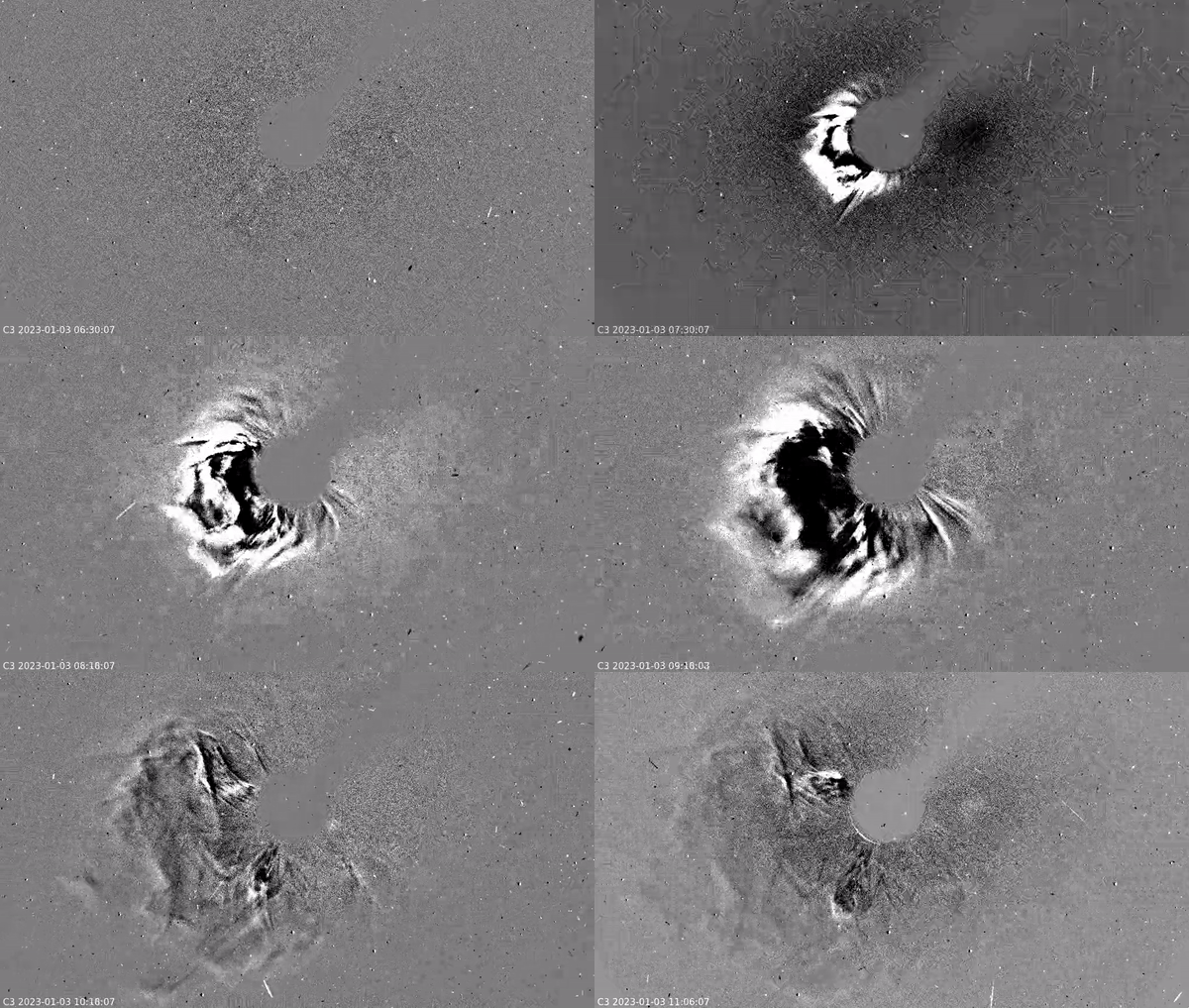
Advanced instruments, such as the Parker Solar Probe and high-resolution solar telescopes, monitored solar plasma flows and magnetic field fluctuations. Ground-based magnetometers complemented these observations, giving a global picture of geomagnetic activity and space weather conditions.
These technologies tracked auroras, radio signal fluctuations, and plasma interactions with Earth’s magnetosphere. Data helped anticipate geomagnetic storms, plan satellite operations, and protect vital infrastructure.
- Real-time magnetometer readings provided early warnings for technological systems
- Satellite shielding was adjusted during peak plasma flows
- Aviation routes were monitored to reduce radiation exposure at high latitudes
Solar Cycle 25 and Long-Term Considerations
The appearance of a massive coronal hole during the late stage of Solar Cycle 25 highlighted the sun’s unpredictable magnetic behaviour. Studying such events improved forecasting of geomagnetic storms. It also informed preparations for future solar maxima.
Continuous observation of solar plasma and magnetic activity helped identify patterns. These patterns allowed scientists to anticipate space weather impacts before they affected Earth. Understanding them ensured resilience in satellite networks, communication systems, and power grids.
As humanity monitored solar and interstellar phenomena, each event added to our knowledge of space weather. It highlighted the dynamic interplay between the sun, interstellar objects, and Earth’s magnetic shield.
Human Implications and Cosmic Perspective
The simultaneous occurrence of a massive coronal hole and the flyby of 3I/ATLAS illustrated Earth’s complex environment. While our magnetic shield remained functional, these events showed the dynamic forces at play in the solar system.
Observing these interactions refined models of geomagnetic behaviour, space weather preparedness, and satellite safety. Public engagement emphasized the importance of scientific literacy in interpreting cosmic events responsibly.
Studying these events offered practical insights for Earth-based technology. It also reminded us of humanity’s place in an active and interconnected cosmic environment.
Conclusion
The convergence of a giant coronal hole and 3I/ATLAS emphasized the need for vigilant monitoring of space weather. Earth’s magnetosphere remained resilient, but continuous observation was essential. Analysis helped understand and mitigate the effects of solar and cosmic activity on technology and infrastructure.


