
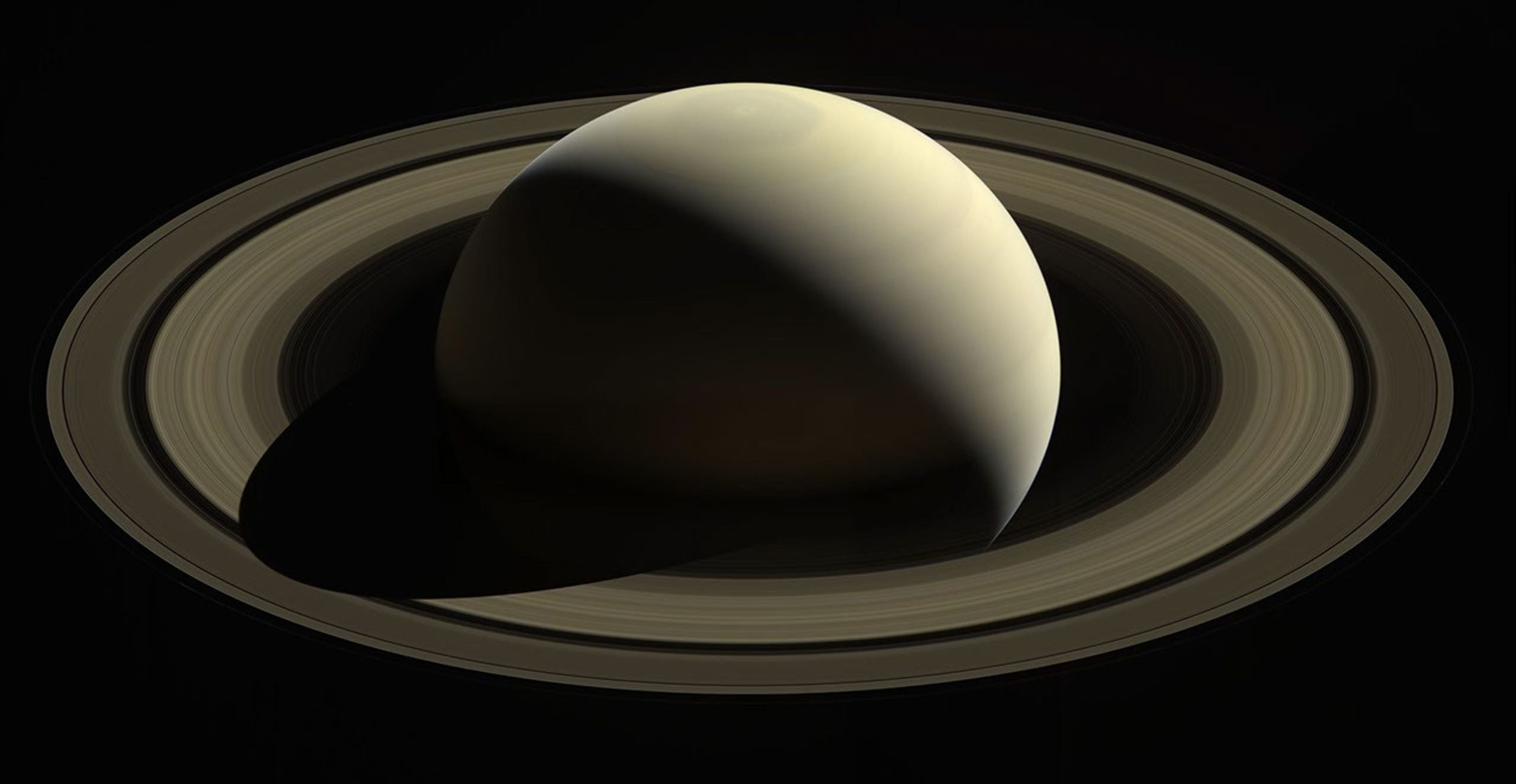
What Cassini’s Final Seconds Actually Revealed — And Scientists Still Can’t Explain It!
As Cassini plunged into Saturn for the last time, it transmitted remarkable discoveries that continue to challenge how scientists understand the ringed giant

On 15 September 2017…
A spacecraft deliberately flew to its death.
For nearly twenty years, Cassini had transformed Saturn from a distant point of light into one of the most closely studied worlds in the Solar System.
Then NASA made an extraordinary decision.
Instead of ending the mission quietly, engineers aimed the spacecraft directly into Saturn’s atmosphere.
There would be no rescue.
No return.
Only one final descent into a place no spacecraft had ever entered.
As Saturn’s atmosphere began tearing Cassini apart, its instruments continued transmitting data across more than a billion kilometres of space.
Every second counted.
Because once the signal disappeared…
There would never be another chance.
What arrived during those final moments did not reveal an impossible secret.
Instead, it left scientists with new questions they are still trying to answer.
The Mission That Was Never Meant to Return

Cassini’s final chapter became known as the Grand Finale.
Rather than ending the mission in a safe orbit, NASA sent the spacecraft through the narrow gap between Saturn and its rings—a region no probe had ever explored before.
The risk was enormous.
The James Webb Telescope Just Changed Everything NASA’s Latest Discovery
Tiny particles travelling at incredible speeds could have destroyed the spacecraft long before its planned ending.
Instead, every successful orbit returned measurements unlike anything scientists had collected before.
Cassini mapped Saturn’s gravity with extraordinary precision, measured its magnetic field and sampled gases, plasma and particles surrounding the giant planet.
Meanwhile, each pass through the gap revealed fresh clues about Saturn’s atmosphere and the true mass of its rings.
The final plunge also protected the future.
By destroying Cassini inside Saturn, NASA ensured the spacecraft could never accidentally contaminate moons such as Enceladus or Titan, worlds that may possess environments capable of supporting microbial life.
What Cassini Found Before Everything Went Silent
Among Cassini’s final discoveries, one result continues to puzzle planetary scientists.
Saturn’s magnetic field appeared almost perfectly symmetrical.
Researchers expected subtle irregularities that would reveal how quickly the planet rotates deep beneath its clouds.
Instead, those irregularities were almost impossible to detect, forcing scientists to rethink long-standing models of Saturn’s interior.
Cassini also delivered another surprise.
Measurements suggested Saturn’s spectacular rings may be far younger than researchers once believed, while ring rain showed the rings are slowly disappearing into the planet itself.
Even today, scientists continue debating what those discoveries reveal about how giant planets evolve.
History has repeatedly shown that the biggest breakthroughs often begin with unexpected observations rather than immediate answers.
Some researchers believe future missions could uncover entirely new processes hidden within Saturn’s atmosphere or its icy moons.
Others wonder whether worlds like Enceladus, with its underground ocean and complex chemistry, could one day reveal evidence of life beyond Earth.
There is currently no evidence that Cassini detected extraterrestrial life or technology.
Nevertheless, its final data reminded scientists that some of the Solar System’s greatest mysteries have yet to be solved.
Final Verdict: Did Cassini Leave One Mystery Behind?
Cassini did not end with one dramatic discovery.
Instead, it ended by opening several scientific debates that continue today.
Its final measurements reshaped our understanding of Saturn’s magnetic field, challenged ideas about the age of its rings and revealed new details about the planet’s atmosphere.
More importantly, they demonstrated how much remains unknown about one of the Solar System’s most remarkable worlds.
Perhaps that is Cassini’s greatest achievement.
Not that it solved every mystery…
But that it uncovered questions nobody expected to ask.
Somewhere beneath Saturn’s clouds…
Within the hidden oceans of its moons…
Or inside data that scientists are still studying…
The next breakthrough may already be waiting.
And one day, Cassini’s final transmission may be remembered not as the end of an extraordinary mission…
But as the moment an entirely new chapter of exploration truly began.
 Watch the Video
What do you think was Cassini’s most important discovery during its final mission—and do you believe Saturn still holds secrets that could transform our understanding of the Solar System?