
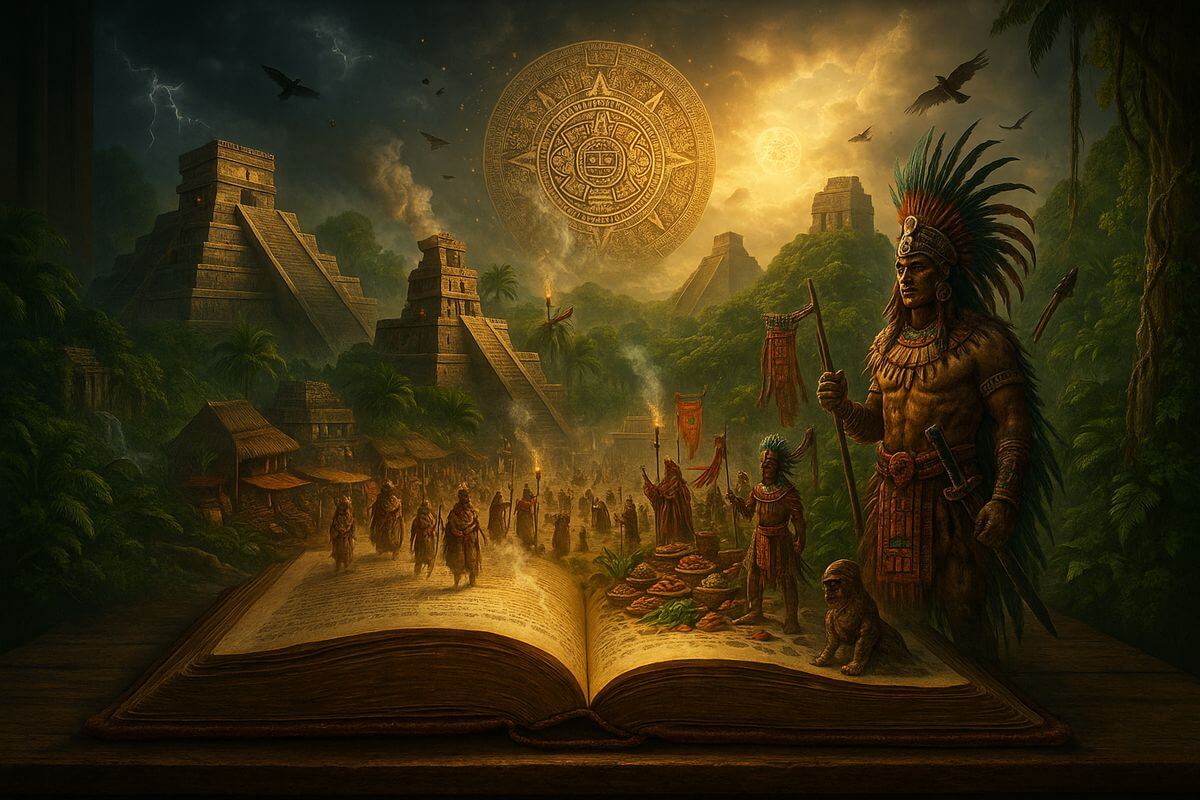
DNA Just Revealed Who The Aztecs Really Were: Graham Hancock Was Right?
New DNA findings reveal surprising truths about Aztec origins, reshaping what we know about their history.

For centuries, the origins of the Aztecs have been shaped by legend, colonial narratives, and fragmented archaeological clues. They appeared in central Mexico as a dominant force, building a vast empire in a relatively short time. This sudden rise led many to question where they truly came from, leaving space for both scientific inquiry and speculation.
Early historical accounts, particularly those recorded after the Spanish conquest, often blended observation with interpretation. These writings emphasized prophecy, migration, and divine guidance, creating an image of a civilization with a mysterious beginning. Over time, this perception opened the door for alternative theories suggesting that their origins might extend far beyond what traditional history describes.
In recent decades, figures like Graham Hancock have popularized the idea that ancient civilizations could be connected to lost advanced cultures. While these ideas gained attention, they lacked concrete scientific backing. Now, advances in genetic research are offering a clearer, evidence-based perspective on where the Aztecs actually came from.
DNA analysis has become one of the most powerful tools for tracing human ancestry. By studying ancient remains, scientists can map genetic relationships across time and geography. In the case of the Aztecs, these findings are not rewriting history with shocking revelations—but they are refining it with precision, replacing mystery with measurable connections.
The Aztecs and Their Legendary Origins

The Aztecs, known as the Mexica, traced their beginnings to a mythical homeland called Aztlan. According to tradition, they migrated southward over generations before settling in the Valley of Mexico. This journey, preserved through oral history, reflects both symbolic meaning and real patterns of movement.
AI Just Decoded Language of Whales What They’re Saying Will Leave You Speechless
Rather than a single migration event, this process likely unfolded over centuries. Groups moved, settled, and merged with others already living in the region. These gradual shifts shaped the cultural and social foundations that would later define the Aztec civilization.
Archaeological evidence supports this layered development. The Aztecs inherited knowledge and traditions from earlier societies, particularly those that had already established complex systems in Mesoamerica. Their rise was built on continuity, not sudden emergence.
What DNA Research Actually Shows
Genetic studies reveal that the Aztecs were closely related to other Indigenous populations in central Mexico. Their DNA reflects long-term interaction among regional groups, confirming a shared ancestry shaped within Mesoamerica itself.
By comparing ancient remains from different time periods, scientists have identified patterns of continuity rather than disruption. These results show that the population was stable yet dynamic, evolving through interaction rather than external replacement.
Crucially, there is no genetic evidence linking the Aztecs to distant continents or unknown civilizations. The data consistently points to regional development, grounded in the history of the Americas.
Migration Patterns in Mesoamerica
Movement has always been central to life in Mesoamerica. Environmental changes, trade opportunities, and social dynamics encouraged populations to shift and adapt over time. These migrations created a network of interconnected communities.
The Aztecs emerged within this environment of constant interaction. Their success came from their ability to integrate into existing systems while expanding their influence through alliances and strategic positioning.
DNA findings reinforce this picture, revealing a web of relationships rather than isolated groups. The region functioned as a cultural crossroads long before the rise of the Aztec Empire.
Debunking the “Lost Civilization” Theory
The idea that the Aztecs were connected to a forgotten global civilization remains unsupported by scientific evidence. While such theories are compelling, they often rely on interpretation rather than verifiable data.
Genetic research provides a grounded alternative, showing that the Aztecs developed within known human migration patterns. Their achievements were the result of innovation within their own cultural context.
Recognizing this does not diminish their accomplishments—it highlights the capabilities of human societies to reach extraordinary levels of complexity independently.
The Role of Archaeology in the Debate
Archaeology has long revealed the sophistication of Aztec society. Excavations of Tenochtitlan show advanced urban planning, engineering, and social organization that rivalled major cities of the time.
These discoveries align closely with genetic findings, both pointing toward gradual development rather than sudden transformation. Each piece of evidence strengthens the overall narrative of continuity.
Together, archaeology and DNA research provide a comprehensive understanding, bridging physical remains with biological history.
Why the Aztecs Seemed “Mysterious”
Much of the perceived mystery comes from how their story was recorded. Spanish chroniclers often described Aztec culture through unfamiliar and sometimes biased perspectives, shaping how it was later understood.
These interpretations emphasized differences rather than connections, making the civilization appear more isolated than it actually was. Over time, this contributed to the belief that their origins were unknown.
Modern research challenges this view, revealing a society deeply rooted in its regional context and connected to a broader human history.
Graham Hancock and Alternative Theories
Theories proposed by Graham Hancock suggest that ancient knowledge may have originated from lost advanced civilizations. While intriguing, these ideas remain outside mainstream scientific consensus.
DNA evidence does not support such connections in the case of the Aztecs. Instead, it reinforces existing models of human migration and cultural exchange within the Americas.
This contrast highlights the difference between speculation and evidence-based research, emphasizing the importance of scientific verification.
The Real Story Is Still Remarkable
Even without extraordinary claims, the history of the Aztecs is extraordinary. They built one of the largest cities in the world and developed complex political and religious systems.
Their success was rooted in adaptation, innovation, and the ability to unify diverse groups under a shared identity. This process reflects the strength of cultural evolution over time.
Understanding their true origins adds depth to their story, showing how complexity can emerge from interconnected communities.
What This Means for Future Research
Advancements in DNA technology continue to open new possibilities for studying ancient populations. As more data becomes available, scientists can refine their understanding of migration and interaction.
For the Aztecs, future research may uncover even more detailed connections between different groups in Mesoamerica. These insights will further clarify how their civilization developed.
The integration of multiple disciplines ensures that our understanding of history continues to evolve, guided by evidence rather than assumption.
Final Thoughts
DNA research does not reveal a hidden or mysterious origin for the Aztecs—it reveals a clearer one. Their roots lie firmly within the Indigenous populations of Mesoamerica, shaped by migration, interaction, and cultural exchange.
While alternative theories continue to capture attention, scientific evidence provides a more reliable foundation. It shows that complex civilizations can arise through natural human processes without external influence.
In the end, the real story of the Aztecs is not less fascinating—it is more grounded, more detailed, and ultimately more meaningful as part of the broader human journey.
 Watch This:
If DNA proves local origins, why do ancient migration myths still appear across so many civilizations worldwide?