



What if Earth has been travelling through space with a mysterious companion hiding in plain sight for decades?
Not a second Moon.
Not a passing asteroid.
Something far stranger.
Astronomers have discovered an object whose orbit keeps it remarkably close to Earth as both worlds circle the Sun.
It has been moving through the same cosmic neighbourhood for decades.
Yet until recently, nobody knew it was there.
The object is known as a quasi-moon—a strange class of space rock that can appear to circle Earth without actually being gravitationally bound to our planet.
So how did it remain hidden for so long?
And where did it come from?
Some researchers have even explored whether unusual objects like this could have origins more complicated than a typical asteroid.
Could there be a connection to ancient collisions, forgotten spacecraft—or, in the most speculative possibility, something artificial?
There is currently no evidence that this object is alien technology.
But the mystery is enough to make astronomers look much closer at the objects sharing our journey around the Sun.
The video below explores this strange Earth quasi-moon, its unusual orbit, and why its discovery could reveal more about what is quietly travelling alongside our planet.
The Strange Object Quietly Following Earth for Decades

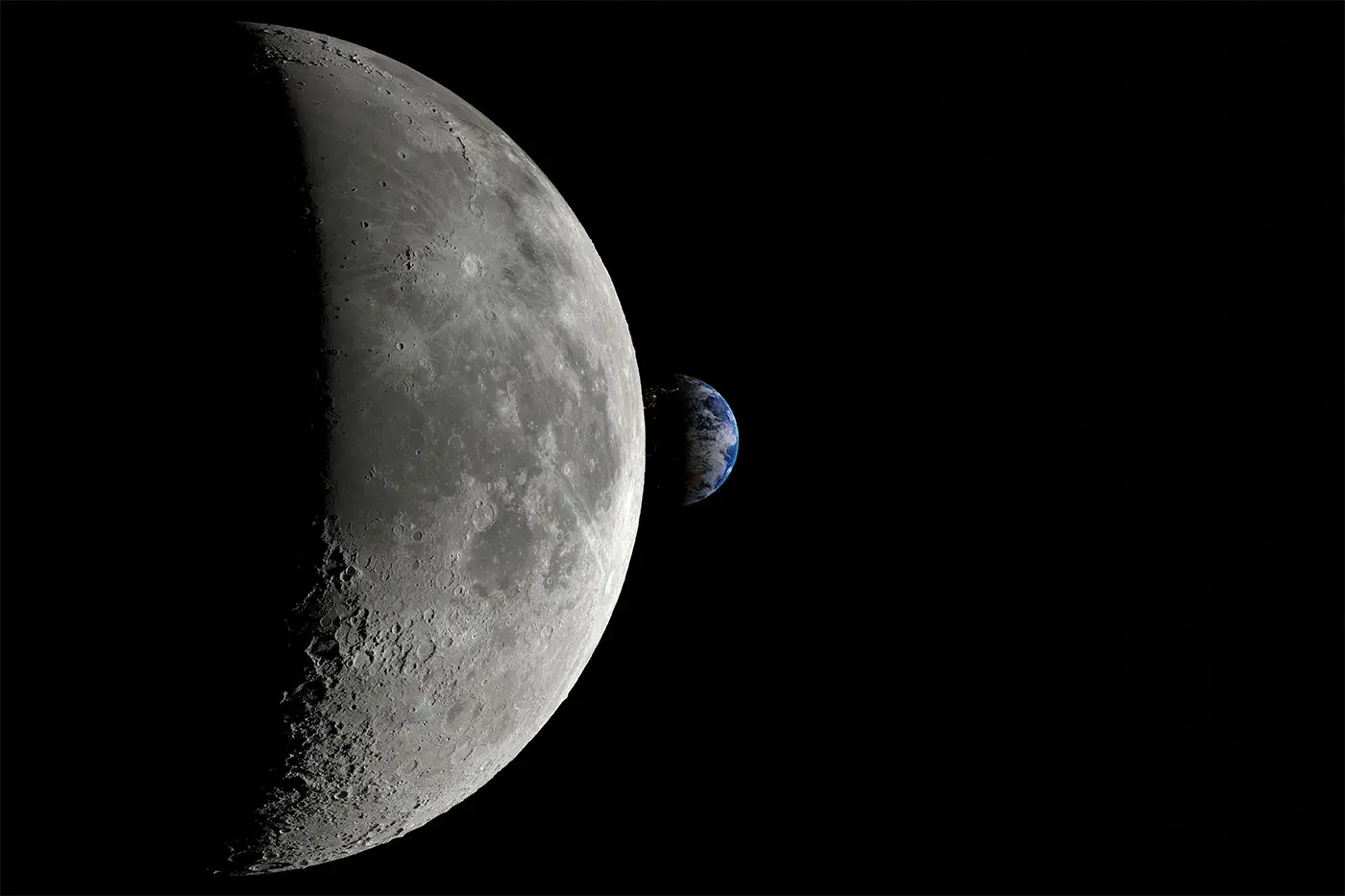
The object is known as 2025 PN7.
Astronomers identified it in August 2025 using the Pan-STARRS 1 survey telescope in Hawaii.
At first glance, it sounds like Earth has gained another Moon.
NASA Confirmed Voyager 1 Just Measured Something That Rewrites Physics!
It has not.
A true orbits Earth.
A quasi-moon instead travels around the Sun while remaining in a close orbital relationship with our planet.
That creates a remarkable effect.
From Earth, the asteroid can appear to loop around our planet.
But the Sun remains the dominant gravitational influence controlling its path.
Orbital calculations suggest 2025 PN7 may have occupied this configuration for roughly six decades.
That makes its discovery even more intriguing.
Something can remain relatively close to Earth for generations while escaping detection.
And astronomers now have an opportunity to study exactly how such objects behave.
Why This Quasi-Moon Has Astronomers Looking Closer

The biggest mystery may not be where 2025 PN7 is.
It is where it came from.
Scientists know that Earth shares its orbital neighbourhood with several unusual near-Earth objects.
Some can enter temporary relationships with our planet.
Others can remain in co-orbital configurations for surprisingly long periods.
One possibility is that 2025 PN7 is simply a natural asteroid following an unusual path.
Another idea is even more interesting.
Researchers have investigated whether material blasted from the Moon by ancient impacts could eventually enter Earth-like orbits.
Then there is the controversial possibility involving human technology.
A 2025 study explored whether 2025 PN7 could potentially be connected to the Soviet Zond 1 mission launched towards Venus in 1964.
That claim remains highly speculative.
It does not prove the object is spacecraft debris.
And it certainly does not prove an alien origin.
Spectroscopic observations would be needed to examine its composition and test competing explanations.
Still, the possibility raises an irresistible question.
What if some objects travelling through near-Earth space have histories we have not yet uncovered?
Final Verdict: What Earth’s Hidden Companion Could Reveal
2025 PN7 is not a second Moon.
It is something more subtle—and arguably more fascinating.
Its unusual asteroid orbit reveals how complicated the gravitational neighbourhood around Earth can be.
Objects can move alongside our planet without actually orbiting it.
They can also remain in these configurations for surprisingly long periods. (planetary.org)
That makes them valuable targets for astronomers.
Their movements can provide clues about how small bodies migrate through the Solar System.
They may also help researchers understand the chaotic processes that shaped our planetary neighbourhood billions of years ago.
And there is another potential benefit.
Some co-orbital objects could eventually become interesting targets for future space missions because their paths can bring them relatively close to Earth.
For now, however, the evidence points towards a natural quasi-moon.
The alien explanation remains speculation.
So does the possibility that this particular object came from an old human spacecraft.
But the discovery still delivers an extraordinary lesson.
Earth may have more cosmic companions than we realise—and some of them could be travelling beside us for decades before we finally notice them.


