
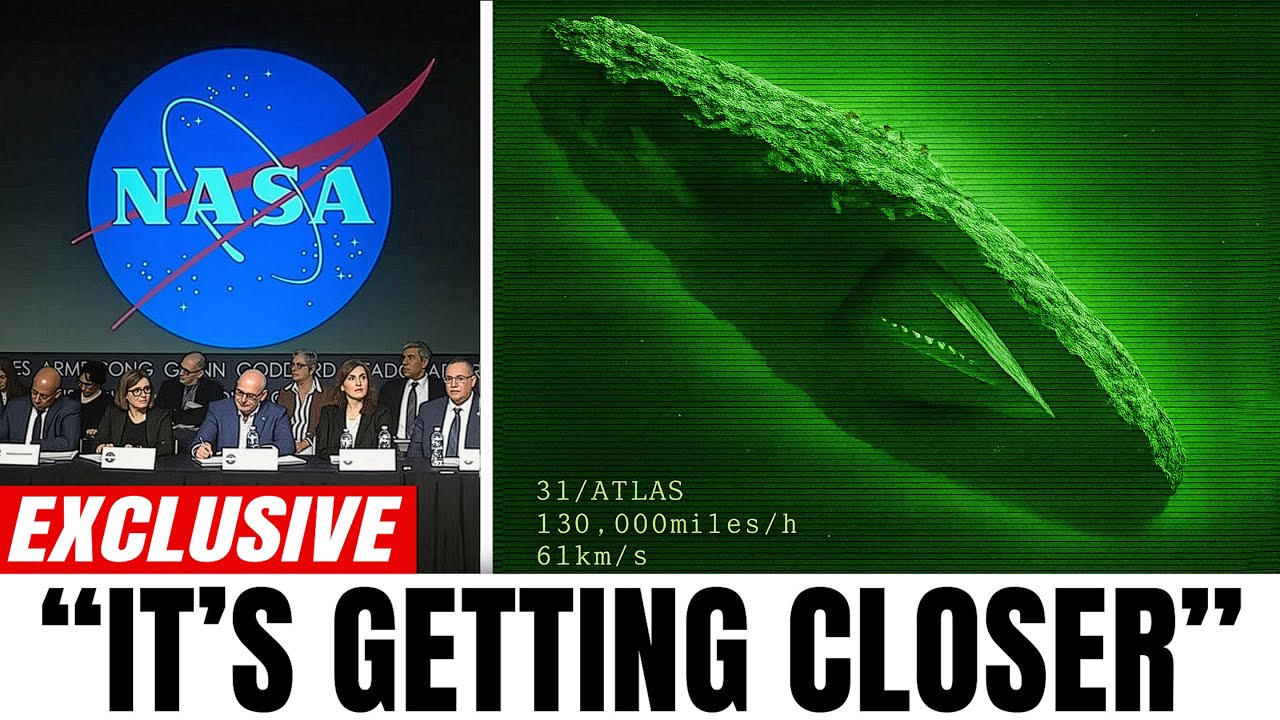
NASA Just Updated 3I/ATLAS’s Size — It’s Large, Not 28 Miles!
NASA has revealed new details about the interstellar object 3I/ATLAS. Its size and behaviour are puzzling scientists—and what it could mean remains unclear.

The universe has once again delivered a mysterious visitor to our solar system: comet 3I/ATLAS. Unlike any comet we’ve seen before, 3I/ATLAS originates from outside our solar system, making it an interstellar object. Its unusual trajectory, strange emissions, and anomalies in behaviour have captivated scientists, astronomers, and enthusiasts worldwide. As October 29, 2025—the day it reaches perihelion—approaches, curiosity and speculation are reaching fever pitch.
This article examines everything known about 3I/ATLAS, the scientific observations, and the conspiracy theories that surround it.
James Webb Telescope Just Captured FIRST, Ever TRUE Image of 3I/ATLAS
Discovery and Initial Observations
3I/ATLAS was first spotted on July 1, 2025, by the Asteroid Terrestrial-impact Last Alert System (ATLAS) in Chile. Its designation, C/2025 N1, distinguishes it as the first interstellar comet detected by this system. The “3I” prefix identifies its interstellar origin, separating it from comets native to our solar system.
Observations confirmed that 3I/ATLAS was traveling at an extraordinary speed, moving too fast to be gravitationally bound to the Sun. Astronomers calculated that it would pass between Earth and Mars, reaching perihelion on October 29, 2025, at approximately 1.36 astronomical units. Its high speed and trajectory make this a once-in-a-lifetime event for observation and study.
Unusual Behaviour and Physical Characteristics
From the beginning, 3I/ATLAS has defied expectations. Its behaviour doesn’t conform to typical cometary patterns, raising eyebrows in the scientific community.
- Colour Shift: The comet is displaying a strange green hue, possibly caused by molecules such as dicarbon or cyanide interacting with sunlight. Spectroscopic analysis is ongoing, but this colour change is unusual for a comet traveling at such speed.
- Tail Anomalies: Unlike conventional comets, 3I/ATLAS’s tail is not trailing directly behind it. Instead, it appears to extend toward the Sun, suggesting that factors beyond solar radiation are influencing its emissions.
- Emission Surges: Gas and dust are being released in an atypical “super-linear” pattern, indicating a possible internal threshold that triggers rapid activity as it heats up. This behaviour is highly unusual and has led to speculation about the comet’s internal structure.
Composition and Structure
Using high-resolution telescopes, including the Hubble Space Telescope and James Webb Space Telescope, astronomers have begun to probe 3I/ATLAS’s composition:
- Nucleus Size: Estimates range from 0.32 to 5.6 kilometres in diameter, though exact measurements are difficult due to the diffuse nature of the object.
- Chemical Makeup: Early studies indicate the presence of water and carbon dioxide, compounds commonly found in comets from our solar system. Despite its interstellar origin, 3I/ATLAS shares some familiar chemical traits with native comets.
- Age and Origin: Some researchers speculate that the comet may be over 7 billion years old, potentially originating from a star cluster older than our solar system. This would make it one of the oldest objects ever observed in our galaxy, offering a glimpse into a period long before Earth formed.
Speculations and Conspiracies
The comet’s unusual characteristics have fuelled speculation, blending scientific curiosity with conspiracy theories.
- Alien Probe Hypothesis: Harvard astrophysicist Avi Loeb has suggested that 3I/ATLAS might be an artificial object—perhaps a probe sent by an extraterrestrial civilization. Its strange trajectory and atypical emissions provide circumstantial evidence, though NASA maintains that all observations align with natural phenomena.
- Technosignatures: Researchers continue to monitor the comet for potential indicators of advanced technology. The unusual emission patterns, tail alignment, and colour shifts keep the possibility open, though no concrete evidence has been detected.
- Solar System Experiment Theory: Some theorists propose that 3I/ATLAS could be part of an experiment by an advanced civilization to test our solar system’s observational capabilities. The comet’s peculiar behaviour might be designed to provoke analysis and study.
- Internal Energy Source Speculation: The rapid surge in emissions has led some to hypothesize that the comet contains an internal energy mechanism, possibly of technological origin, which activates as it approaches the Sun.
Observational Challenges
Observing 3I/ATLAS is not without its challenges.
- Visibility: As the comet nears perihelion, it will pass behind the Sun from Earth’s perspective, making direct observation difficult. Scientists are relying on telescopes positioned around the world and in orbit to track its activity.
- Data Collection: Despite observational limitations, data from Hubble, James Webb, and ground-based observatories continue to flow. Amateur astronomers have also contributed sightings and observations, providing valuable real-time data.
Global Response and Monitoring
Observatories worldwide are coordinating to monitor 3I/ATLAS. In addition to major telescopes, numerous amateur astronomers are documenting the comet’s behaviour. Social media and scientific forums are buzzing with updates, theories, and live observations.
This global response highlights the comet’s significance and the public’s fascination with potential extraterrestrial phenomena.
The Clock Is Ticking
October 29, 2025, is the critical date when 3I/ATLAS reaches perihelion. This moment is pivotal for both observation and speculation. Scientists hope to capture the comet’s closest approach to the Sun, potentially revealing structural changes, emission patterns, or other anomalies.
For conspiracy theorists, this date has become a marker of potential cosmic significance.
Potential Implications for Humanity
If 3I/ATLAS were to contain technological artefacts, signals, or other signs of intelligence, the implications would be profound:
- Extraterrestrial Life Evidence: Detecting technosignatures would be the first credible evidence of advanced alien civilizations.
- Security Considerations: Questions about artificial origin raise concerns about potential risks to Earth or its orbital infrastructure.
- Scientific Breakthroughs: Studying the comet could reveal unknown elements, isotopes, or energy processes that may revolutionize physics, astronomy, and our understanding of interstellar objects.
Why it Matters
Beyond speculation, 3I/ATLAS offers humanity an unprecedented opportunity to study materials from outside our solar system. Its chemical composition, emission patterns, and trajectory can shed light on the processes governing distant star systems. The comet also serves as a reminder of how little we know about the universe and the possibilities that may exist beyond our observational reach.
Conclusion
Comet 3I/ATLAS is more than a visitor; it is a cosmic puzzle. Its unusual behaviour, strange emissions, and the speculation surrounding its origin make it one of the most intriguing objects observed in recent decades. Whether natural or artificial, 3I/ATLAS provides humanity with a rare window into the unknown. As the world counts down to October 29, 2025, the scientific community and the public alike are bracing for revelations that could challenge our understanding of the cosmos.
This is a moment to watch the skies closely and question what we think we know about the universe.
 Watch This:
Check out the astonishing footage of 3I/ATLAS—its strange emissions and unusual tail will leave you questioning what’s really visiting our solar system.
* * *
You’ll Love This One …
NASA: ALIEN Civilization Spotted On Proxima B – Signal Confirms It!
Humanity on the Verge of a Cosmic Revelation
For centuries, humans have gazed at the stars, wondering if life exists beyond Earth. Now, a signal from Proxima B—the closest Earth-like exoplanet—has reignited that question with urgency. Unlike previous exoplanetary discoveries, this signal shows structure, repetition, and mathematical precision. These features suggest deliberate design rather than natural cosmic phenomena.
The James Webb Space Telescope captured the transmission clearly. Early analyses indicate a complex source. Its structure differs from typical cosmic noise, making it impossible to dismiss. Scientists approach the discovery with caution, yet the evidence demands attention. Beyond science, speculation runs wild. Some suggest alien observation. Others warn of interstellar tests or hidden warnings. This signal hints at a universe far more interactive than humans imagined.
* * *
READ NEXT: James Webb Telescope Just Detected 755 Unidentified Objects Arriving From Another Solar System
Trending Now: Google’s Quantum AI JUST SHATTERED JAMES WEBB TELESCOPE
Stay Connected: Follow us on Telegram for the latest shocking discoveries and exclusive stories!
Got thoughts or tips? Drop a comment below — we love hearing from you!
What do you think 3I/ATLAS really is—just a comet, or something far stranger visiting our solar system?