
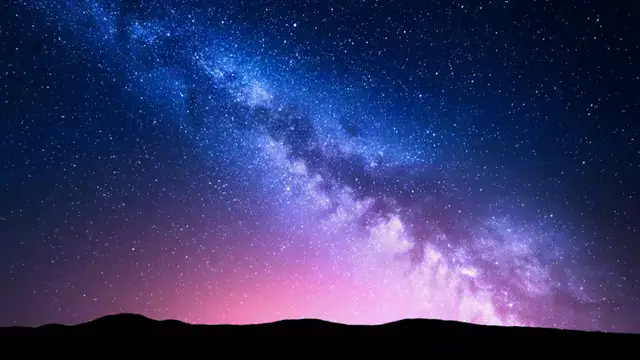
Scientist Claims To Have Found The ‘Exact Location of Heaven’ With Mind-Blowing Theory
Dr. Michael Guillen, a former Harvard physics instructor, shared his astonishing new theory in an open essay!

For centuries, the existence of ‘heaven’ has proven to be a polarising debate, with scientists and theologians alike rarely seeing eye to eye. Religion has traditionally framed heaven as a divine realm beyond human reach, while science has focused on observable, measurable reality. As a result, the two perspectives have often appeared fundamentally incompatible.
Yet despite this divide, questions about heaven’s nature and location continue to resurface, especially as modern science pushes deeper into the mysteries of the universe.
Popular Culture’s Image of Heaven

Popular culture and religious art have long portrayed heaven as a realm of glowing clouds, golden light, and winged angels floating above the Earth. These images have shaped public imagination for centuries, reinforcing the idea that heaven exists somewhere high above the physical world.
However, some scientists argue that such depictions may be symbolic rather than literal, suggesting the true nature of heaven—if it exists—could be far more complex and unfamiliar.
A Scientist Challenges Traditional Ideas
Dr. Michael Guillen, a former Harvard lecturer who holds PhDs in physics, mathematics, and astronomy, has put forward a controversial theory suggesting that heaven may have a real, physical location tied to the structure of the universe itself.
Scientists Discover Natural Molecule That Wipes Out 90% of Cavity-Causing Plaque
In an open essay, Guillen explained that his ideas are not based on speculation alone, but on established principles of cosmology and physics.
The Expanding Universe and Edwin Hubble
Guillen begins his reasoning with a discovery made nearly a century ago. In 1929, American attorney-turned-astronomer Edwin Hubble discovered that galaxies are rushing away from one another, as if propelled outward by a massive explosion.
Hubble also identified a clear pattern: the farther a galaxy is from Earth, the faster it is moving away. This observation fundamentally changed humanity’s understanding of the universe and laid the foundation for modern cosmology.
Understanding the Cosmic Horizon
Drawing from Hubble’s research, Guillen explains that there is a theoretical boundary in the universe where galaxies appear to move away at the speed of light. This boundary is known as the Cosmic Horizon.
According to Einstein’s theory of relativity, nothing with mass can travel faster than light. As a result, the Cosmic Horizon represents a limit that humans can never reach, no matter how advanced technology becomes.
Why the Cosmic Horizon Is Unreachable
At approximately 273 billion trillion miles away, space itself expands so rapidly that any attempt to reach the Cosmic Horizon would fail. Even the most powerful spacecraft imaginable could never cross it.
This permanent inaccessibility is a key reason Guillen believes the Cosmic Horizon may align with religious descriptions of heaven as a realm unreachable by living humans.
Biblical Descriptions of Heaven
According to biblical interpretations, heaven is often described in multiple levels. The lowest level is Earth’s atmosphere, the middle level is outer space, and the highest level is the dwelling place of God.
Guillen suggests that this highest level corresponds to the Cosmic Horizon—the furthest possible “up” in the known universe.
Looking Up Toward Heaven
Scripture frequently refers to humanity looking “up” toward heaven and God looking “down” upon Earth. While often interpreted symbolically, Guillen argues these descriptions may also reflect a literal cosmic orientation.
The Cosmic Horizon, located at the extreme edge of the observable universe, fits this description more closely than any traditional image of heaven.
What Happens to Time at the Cosmic Horizon
One of the most intriguing aspects of Guillen’s theory involves time itself. According to modern cosmology, time behaves unusually near the Cosmic Horizon.
Scientific observations suggest that time effectively comes to a stop at this boundary. There is no past, present, or future—only timelessness.
Timelessness and Religious Belief
This concept closely mirrors religious descriptions of heaven as eternal and unchanging. The absence of time aligns with the belief that heaven exists beyond aging, decay, and death.
For Guillen, this similarity strengthens the argument that the Cosmic Horizon could be connected to the biblical concept of heaven.
Space Beyond the Cosmic Horizon
While time may cease at the Cosmic Horizon, space itself does not disappear. Cosmologists believe that space continues beyond this boundary, forming a hidden universe that remains permanently inaccessible to humans.
This hidden realm could exist under conditions entirely different from those within the observable universe.
A Realm for Non-Material Beings
Guillen suggests that the universe beyond the Cosmic Horizon may be habitable only by non-material or light-like entities. This aligns with religious descriptions of heaven as a place inhabited by spiritual beings rather than physical bodies.
Such a realm would exist outside the limitations of matter and time.
Older Than the Big Bang
The Cosmic Horizon is lined with the oldest observable objects in the universe. Anything beyond it would predate these ancient structures and may even predate the Big Bang itself.
This idea aligns with theological claims that heaven is the dwelling place of a creator that existed before the universe began.
Science, Belief, and Controversy
Guillen does not claim definitive proof of heaven. Instead, he presents a framework where science and religion may coexist without directly contradicting one another.
His theory has sparked debate among scientists and theologians, with critics arguing that cosmology should remain separate from spiritual belief, while others see value in exploring their overlap.
A Mystery That Remains Unanswered
The exact location of heaven remains unknown. However, theories like Guillen’s encourage deeper reflection on the limits of human knowledge and the structure of the universe.
Whether viewed as science, belief, or speculation, the idea that heaven may exist at the very edge of the cosmos continues to challenge and inspire curiosity about what lies beyond the observable universe.
 Watch This:
If the Cosmic Horizon is real and unreachable, could it match ancient descriptions of heaven?