
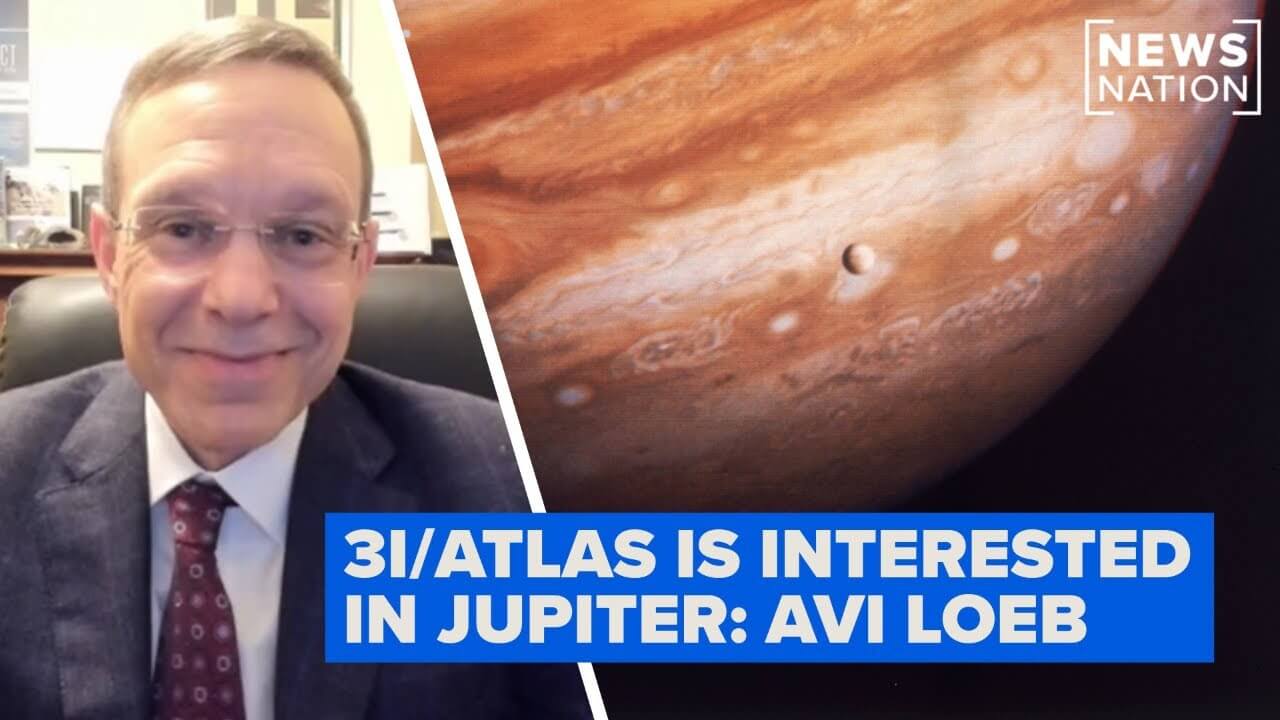
Avi Loeb’s Latest 3I/ATLAS Theory: It’s Interested In Jupiter
Avi Loeb challenges NASA’s view of 3I/ATLAS, pointing to its precise path toward Jupiter in 2026 and suggesting the object may have a deeper purpose.

Harvard astrophysicist Avi Loeb has sparked global debate by suggesting that 3I/ATLAS may not be a comet, but an interstellar probe navigating our solar system. He highlights unusual patterns in speed, trajectory, and behaviour that challenge NASA’s classification. If Loeb’s analysis is correct, this object could represent one of the most remarkable celestial visitors observed in recent years.
Why Avi Loeb Rejects the “Comet” Label
Loeb argues that 3I/ATLAS behaves in ways inconsistent with known comet physics. Its brightness, trajectory, and lack of visible outgassing make a natural explanation uncertain. Calling it a comet, he warns, might overlook extraordinary possibilities.
He stresses that anomalies should be examined, not dismissed. “If it looks strange and behaves strangely, maybe it is something we haven’t seen before,” Loeb notes. Ignoring unusual features could prevent a major scientific discovery.
Some subtle deviations, like unexpected accelerations or slight shifts in course, could indicate engineered components or unknown natural phenomena. Loeb insists these clues deserve careful study rather than quick categorization.
The Jupiter Rendezvous and the Question of Intent
Loeb points to 3I/ATLAS’s upcoming approach to Jupiter on March 16, 2026, as particularly significant. Its trajectory toward the planet appears unusually precise. “It comes exactly at the right distance from Jupiter for Jupiter’s gravity to dominate,” he explains.
If 3I/ATLAS is a probe, Jupiter’s gravity could serve multiple purposes: adjusting its path, slowing its speed, or deploying smaller instruments. The planet’s strong magnetic field could also enable observations of the surrounding environment.
Natural comets rarely pass so precisely at an optimal gravitational point. Loeb suggests this alignment could indicate purposeful navigation or advanced engineering, making the encounter a crucial opportunity for observation.
The Anomalous Speed and Non-Gravitational Motion
3I/ATLAS exhibits slight deviations from predicted gravitational behaviour. These non-gravitational movements are reminiscent of the patterns seen with ‘Oumuamua, which Loeb previously considered potentially artificial. “Nature doesn’t fine-tune motion to this degree. Technology does,” he remarks.
The 12th Anomaly of 3I/ATLAS — Locked Jets Defy Physics
Its velocity remains unusually steady despite solar radiation influences, suggesting either reflective materials or controlled manoeuvring.
Observed anomalies across multiple interstellar objects support Loeb’s argument that further study is essential. Overlooking them risks missing transformative scientific insights.
Loeb’s Comparison to Previous Interstellar Visitors
Loeb compares 3I/ATLAS to ‘Oumuamua, which showed unusual acceleration, atypical geometry, and minimal outgassing. These features defy conventional explanations for interstellar objects.
Repeated irregularities in trajectory and behaviour suggest a pattern rather than random occurrence. Careful observation could uncover phenomena that current models cannot explain.
According to Loeb, interstellar space might contain relics of advanced civilizations, and identifying these patterns could expand our understanding of technology beyond Earth.
The Possibility of Artificial Construction
Certain features of 3I/ATLAS hint at artificial design, according to Loeb. Its structural stability, smooth reflectivity, and resistance to fragmentation suggest engineered materials rather than a natural comet.
He proposes that interstellar probes could be crafted from durable, lightweight materials to survive long journeys while blending into the cosmic environment.
Loeb emphasizes the importance of considering the possibility of long-travelled technological artefacts. “Their technology might blend into nature — until you look closely,” he says.
Evidence NASA Overlooks Too Quickly
Loeb criticizes NASA and other agencies for rapidly categorizing unknown objects as comets or asteroids. He argues that caution should not prevent proper analysis of unusual data.
Premature classification could obscure discoveries. Loeb stresses the importance of exploring alternative explanations and following the data wherever it leads.
He insists that scientific investigation must remain open-minded. “We should never let fear of ridicule guide our conclusions,” he notes, warning that dismissing anomalies could delay understanding of interstellar visitors.
Why an Extraterrestrial Probe Might Target Jupiter
Jupiter provides multiple advantages if 3I/ATLAS is a probe. Its gravity could adjust trajectory or slow the object, while its magnetic field may allow it to collect environmental data. Additionally, the planet could act as a staging point to release smaller instruments deeper into the solar system.
Loeb emphasizes that these benefits make Jupiter a highly strategic target, as natural comets rarely align so precisely with planetary features.
Signs of Possible Engineering
Several features point to potential engineering. Minor non-gravitational accelerations, consistent reflectivity, and minimal gas emissions distinguish 3I/ATLAS from typical comets.
These characteristics, observed across multiple sessions, suggest the object may be designed to endure interstellar travel. Loeb believes such traits warrant close monitoring during its approach to Jupiter.
Why Loeb Thinks Earth Should Pay Attention
The increasing frequency of interstellar object detections suggests a pattern worth investigating. Studying 3I/ATLAS could offer insights into civilizations far older and more technologically advanced than ours.
Loeb emphasizes that observing the object might reveal new information on interstellar navigation, materials, or technologies.
Failing to investigate could mean missing one of the most significant scientific opportunities of our era.
Preparing for the 2026 Jupiter Encounter
The 2026 flyby near Jupiter will provide an unprecedented chance to study 3I/ATLAS under extreme gravitational influence. Loeb predicts this encounter could reveal controlled or unusual behaviour, key evidence of artificial origin.
He encourages global coordination among telescopes and space agencies to maximize data collection. Observing even subtle deviations, reflective changes, or other unexpected effects could provide critical insights.
If the object demonstrates engineered behaviour, the flyby could confirm suspicions about its artificial nature.
Could 3I/ATLAS Be Sending Signals?
Loeb also suggests 3I/ATLAS may emit faint signals, such as radio waves or reflective patterns. Jupiter’s magnetic field could amplify these emissions, offering a rare opportunity to detect them.
Past monitoring has been limited, making systematic observation during the flyby essential. Detecting signals would provide strong support for the probe hypothesis.
Ignoring this possibility risks missing critical evidence. “If we don’t ask the question, we guarantee we won’t find the answer,” Loeb says.
 Watch This:
Do you think 3I/ATLAS is simply a comet, or could it truly be an artificial probe exploring our solar system?