


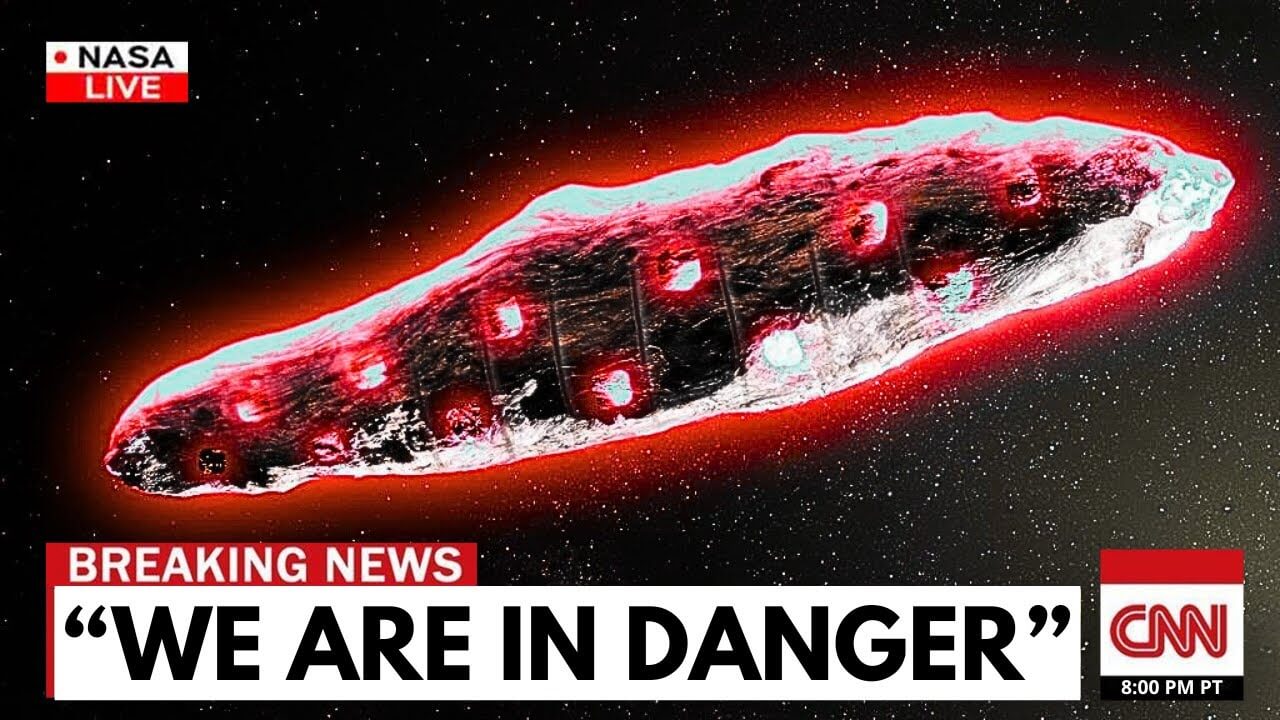
The ARRIVAL!
In the summer of 2025, astronomers tracking the skies were stunned by a new discovery: an interstellar object dubbed 3I/ATLAS. Unlike typical comets passing through the solar system, this object arrived from the depths of interstellar space, bearing a size and trajectory that immediately set it apart from all known celestial wanderers. Observatories worldwide focused their attention on this cosmic visitor, anticipating an unusual but natural cometary display.
At first, 3I/ATLAS seemed ordinary. Its motion followed predictable gravitational physics, and its early light reflected the soft green glow typical of diatomic carbon in cometary comas. Yet, within weeks, subtle anomalies began to appear. The object’s colour started shifting in a way that puzzled scientists. Where a natural comet should maintain a consistent hue under solar illumination, 3I/ATLAS began to radiate a deep, pulsating crimson.
The implications were profound. A comet that emits its own light suggests internal processes far beyond ordinary sublimation. This discovery set the stage for a wave of speculation. Was it an entirely new type of celestial body, or could it be something deliberately designed? Humanity’s understanding of interstellar objects was about to be tested like never before.
Unusual Coloration: A Cosmic Alarm
Comets typically glow due to sunlight reflecting off gases and dust, most often creating greenish or bluish hues. 3I/ATLAS defied this pattern, radiating a uniform crimson that hinted at internal emission rather than mere reflection. This unusual colour was a siren call to astronomers: something about this object was fundamentally different from anything catalogued before.
The James Webb Space Telescope captured the phenomenon in exquisite detail. Its instruments revealed that 3I/ATLAS contained significant carbon compounds and complex organic molecules, yet the emission intensity suggested an active energy source inside the object itself. This was not a passive comet merely reacting to the Sun; it appeared to be generating light in a controlled, uniform fashion.
Such a stark deviation from natural cometary physics fuelled speculation. Could a natural object evolve this way? Or was 3I/ATLAS exhibiting signs of artificial engineering? Scientists began to debate whether the crimson glow was a warning, an activation signal, or an unknown physical process yet to be understood.
The Role of the James Webb Space Telescope
The JWST became the critical tool for unlocking 3I/ATLAS’s secrets. Using its advanced infrared and spectroscopic capabilities, it revealed details invisible to previous telescopes. The object’s coma spanned hundreds of thousands of kilometres, rich in carbon dioxide, water, and carbon monoxide. Its emission spectrum indicated energy being radiated from inside, rather than reflected, strengthening the sense that this was no ordinary comet.
As JWST continued monitoring, scientists noticed subtle shifts in 3I/ATLAS’s light patterns. It appeared to react to solar proximity, brightening in specific wavelengths at precise intervals. These patterns resembled signals more than natural fluctuations, prompting some to suggest the object might be a probe or an automated sentinel from beyond our solar system.
Beyond physical analysis, JWST provided an unprecedented visual record of the object’s movement, rotation, and the way its light shifted across the coma. Each frame deepened the mystery, showing behaviour that could not be explained by standard cometary physics alone. It was a reminder that the universe still held phenomena capable of challenging humanity’s assumptions.
Theories of Artificial Origin
Speculation about artificial origins grew as more data poured in. Avi Loeb and other astrophysicists pointed to the object’s trajectory, light emission, and lack of a conventional tail as anomalies inconsistent with natural formation. If 3I/ATLAS was constructed or manipulated, its arrival might be deliberate, and the colour changes could serve as a signal or activation mechanism.
Not all scientists accepted these ideas. Many stressed that natural processes remain poorly understood at interstellar scales, and a rare combination of gases and sunlight could theoretically produce unusual effects. Yet even sceptics admitted that the combination of size, emission behaviour, and colour transformation placed 3I/ATLAS in a category that defied simple explanations.
Regardless of origin, the debate underscores a deeper question: are there natural celestial objects that already possess abilities or behaviours we have not yet imagined, or does the universe contain artefacts left by advanced intelligences beyond our solar system? The answer may reshape humanity’s view of our place in the cosmos.
The Activation Hypothesis
As 3I/ATLAS neared the Sun, its behaviour intensified. Red light transitioned to a faint green glow, accompanied by subtle outgassing of cyanide and metallic elements. Researchers proposed an “activation hypothesis,” suggesting the object contained a mechanism responsive to solar energy. This theory implies that 3I/ATLAS could contain latent technology or an energy system capable of regulating its emission.
If true, such a mechanism would challenge existing astrophysical knowledge. No known natural processes allow a comet to change its emission wavelength deliberately in response to sunlight. This behaviour implied intelligence or design, even if the object’s true purpose remained obscure.
The activation hypothesis also prompted concerns about potential effects on nearby planets. While 3I/ATLAS poses no immediate threat to Earth, its energy emissions and unusual trajectory raise questions about how interstellar objects might interact with solar system bodies in unforeseen ways. The stage was set for a close observation as the object approached perihelion.
The Absence of a Cometary Tail
Unlike typical comets, 3I/ATLAS displayed only a faint glow rather than a sweeping tail. This absence challenged conventional models of sublimation, suggesting that the object might not lose material in the usual manner. Instead, it seemed to maintain structural integrity while emitting energy, reinforcing ideas of artificial composition.
The lack of a tail also provided clues about the internal processes at work. It suggested that the object’s emissions were controlled, rather than the result of random outgassing. This subtle but critical difference changed how astronomers interpreted its trajectory and behaviour.
Researchers began to consider the possibility that 3I/ATLAS was a probe designed to survive close passes to stars, emitting energy selectively to avoid destruction. Such speculation borders on science fiction, yet every new observation supported the notion that this object was anything but ordinary.
The Close Encounter with Mars
In October 2025, 3I/ATLAS passed within 18.5 million miles of Mars. Spacecraft orbiting the Red Planet provided unprecedented vantage points, capturing detailed imagery and spectral data. Observations suggested minor gravitational interactions but no deflection significant enough to alter its course drastically.
Despite the lack of impact, scientists used the opportunity to refine models of the object’s internal structure and composition. Measurements revealed temperature fluctuations and light patterns that strengthened the case for an energy-generating system within the body. Each new observation amplified the sense that 3I/ATLAS might be more than a transient visitor—it could be an intentional traveller.
The encounter also sparked renewed public interest. Media coverage and scientific publications speculated on possible messages or signals encoded within the object’s colour changes. The Mars pass became a focal point for global discussions on interstellar mysteries, conspiracy theories, and the potential for intelligent artefacts in space.
The Upcoming Perihelion
3I/ATLAS is expected to reach its perihelion later in 2025, passing closer to the Sun than previously observed. Scientists anticipate dramatic changes in emission patterns, possibly revealing mechanisms hidden until now. The perihelion event represents the culmination of months of observation and speculation.
Predicting its behaviour is difficult. If the activation hypothesis holds, the object may exhibit new light shifts, rapid outgassing, or other unexpected phenomena. Each possible outcome could provide clues about the internal processes that drive its unusual characteristics.
Public and scientific attention is now focused on this approach, with telescopes worldwide ready to capture every detail. The perihelion may answer some questions—but likely, it will raise even more, pushing the boundaries of our understanding of interstellar visitors.
Implications for Astrophysics
3I/ATLAS challenges conventional models of cometary physics and interstellar dynamics. Its presence suggests that interstellar space may contain objects with properties we have not yet imagined, from natural anomalies to potential intelligent artefacts.
The implications extend beyond comet science. Planetary defence, astrophysical theory, and the search for extraterrestrial intelligence must all account for bodies that behave outside normal expectations. If 3I/ATLAS is artificial, it represents a first encounter with interstellar engineering, demanding new frameworks for observation and analysis.
Even if natural, 3I/ATLAS highlights the limits of current models. Astrophysicists must consider rare chemical combinations, unknown reactions, and energy dynamics that can produce behaviour far different from anything in our solar system. This object has become a case study in cosmic unpredictability.
Preparing for Future Encounters
3I/ATLAS serves as a warning and an opportunity. Its unique properties demand improved detection systems, enhanced monitoring of interstellar objects, and the development of theoretical models that incorporate both natural and artificial possibilities.
Future encounters may involve objects more enigmatic or closer to Earth. The scientific community now recognises the necessity of preparing for anomalies that challenge our understanding of physics and cosmic origins. 3I/ATLAS may be only the first of many discoveries to come.
Regardless of its origin, the object has sparked renewed curiosity about what lies beyond our solar system and how intelligent life or natural phenomena might manifest in ways we cannot yet comprehend.


Watch the latest James Webb footage of 3I/ATLAS as it shifts colour and emits strange light patterns—revealing mysteries never seen before in space.
* * *

You’ll Love This One …
3I/ATLAS’s Final Signal JUST WARNED THE WORLD

An Unprecedented Cosmic Event
In July 2025, astronomers observed a phenomenon that immediately captivated the scientific community. The interstellar object 3I/ATLAS transmitted a signal unlike anything previously recorded, suggesting intelligence or an unknown cosmic process behind it.
The transmission, brief yet complex, displayed sequences and patterns that challenged standard astrophysical understanding. Scientists worldwide began collaborating to decode its hidden meaning, raising the possibility of humanity’s first contact with a message from beyond our solar system.
Questions abound: Was this a natural anomaly, a warning, or an intentional communication from an advanced intelligence? The enigmatic nature of the signal has set the stage for one of the most ambitious scientific investigations in recent history.
* * *
READ NEXT: Bill Nye Just Issued A Serious Warning After 3I/ATLAS Shifted Course
Trending Now: Elon Musk: “3I/ATLAS Is Coming Towards Us & It’s Unstoppable”
Stay Connected: Follow us on Telegram for the latest shocking discoveries and exclusive stories!
Got thoughts or tips? Drop a comment below — we love hearing from you!